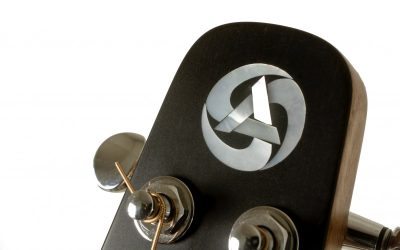
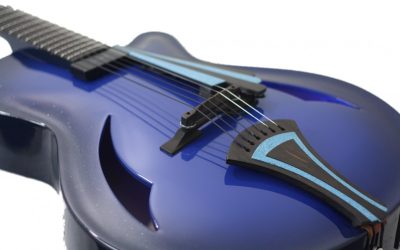
Custom inlays
Bailey Custom Bandsman Build – Norwegian Wood – Part 1
Feb 24th
Making the Neck – Stage 1
- Fretboard and Neck Blanks
- The blanks are prepared
- The neck is marked out
- Test fitting the trussrod
- The neck is cut out
- Installing the truss rod
This guitar is based on the Bailey Bandsman with a few extra custom options.
I usually start by making the fretboard, as it is very handy to have for marking out the neck. Instead of using a drawing and transferring measurements, I can use the real thing, so it is quicker and more accurate.
The trussrod slot is much easier to do while the neck is still a square block of wood, using a simple fence guide on the router. Then the headstock angle is rough cut on the bandsaw, before routing it perfectly flat using my jig.
Then the rest of the neck can be cut out. This is a two stage process:
1 – Roughly bandsaw the neck leaving 2-3mm outside the line.
2 – ‘Profile’ the neck using the router to copy a pattern into the wood.
After this, I route the back surface of the headstock until it is the correct thickness for the tuners, usually about 15-15.5mm.
Now the back of the headstock is nice and flat I am able to drill the tuner holes on the pedestal drill.
Having done all that it is time to install the truss rod. A small fillet of wood is glued over the rod to hold it in place. This avoids any problems caused by a loose fitting rod which may otherwise rattle or buzz while playing.
Next job is to glue the fretboard on. I also have to glue the cap to the body blank pretty soon so I can start work on the body…keep an eye on the blog to see how work is progressing
As you can see, all my guitars are individually handmade. I do not have a pile of necks and bodies to go through like in the old days at the factory, so I have the luxury of totally dedicating myself to each one. People often ask me which guitar I enjoy making the most – the truth is, it is always the one I am making right now!
Imagine watching your custom guitar take shape with regular updates and pics? If you are interested, have a look at some more of our guitars. Any of these can be customised to your own preferences, or if you have an idea for your own shape we can build it for you, Contact Us with your required spec for a quote.
Build yor own acoustic guitar – BYOA-017
Dec 20th
Duncan made this acoustic guitar here at the Bailey workshop on our Build Your Own Guitar course
- BYOA-017
- Sitka Spruce top
- Rear view
- Myrtlewood back
- Myrtlewood
- Custom headstock inlay
- Duncan’s collection
- Nice work Dunk!
Duncan has been a few times before to build electric guitars, but this is his first acoustic. The shape is based on the Bailey Bootlegger but he designed his own bridge and chose a larger headstock than the standard. He also carefully selected every piece of timber from our wood store to make what has to be one of the most spectacular guitars ever made on the BYO course.
The body has Myrtlewood back and sides and a Sitka spruce top and is bound with rosewood. As if the wood itself wasn’t beautiful enough Duncan also used abalone for the rosette and crown inlays, not forgetting the elaborate ‘Watson/Eagle’ logo on headstock.
Imagine playing a guitar you have made yourself? Now you can!
Check prices and dates | more courses
Build Your Own Custom Guitar – 27 Aug to 4 Sept – BYO-295
Nov 9th
Kevin pushes the boundaries with his first guitar made on our Build Your Own Custom Guitar Course.
- BYO-295
- neck thru body construction
- Carved top
- Chrome hardware
- Flame orange – custom colour
- Cream P90 in the neck position
- Rear view of thru neck
- 3 a side chrome tuners
- Custom inlay
- Custom fretboard inlay
- Close up of pearl inlay
- Kevin made his own guitar
Kevin made his first guitar on a recent build your own custom course here at the Bailey Workshop. It took seven days to create this instrument from raw blocks of wood which shows you just what is possible on our course. He wanted a neck thru, carved top, electric guitar with ‘flame orange’ maple cap and custom girl inlay on the headstock and custom lettering on the 12th fret, so his design really pushed the boundaries of what is possible, but he was a very fast worker!
He chose to have a humbucker (with a coil cut built into the tone control) at the bridge, and a P90 in the neck position. This gives a wide range of tones at the flick of a switch.
To save time the inlays were made by our good friends at Small Wonder, so all Kevin had to do was inlay the ready made ‘girl’ shape into the headstock and the letters into the fretboard. Incidentaly we asked for just mother of pearl but Mike at Small wonder couldn’t help himself from making the shoes red!
Thankfully Kevin liked it like that, and I had to agree Mike was right…
Check prices and availability | more courses
Bailey custom acoustic guitar- Ziricote and Bearclaw Bootlegger-P6
Sep 22nd
Making the neck
Read part 1, part 2, part 3, part 4, part 5
- Routing the truss rod slot
- Gluing on the fretboard
- Carving the heel
- The neck is test fitted
- Mother of pearl marker dots
- Laying out the headstock inlays
- The paper pattern is glued to the mother of pearl blank
- Drilling the penguins eye
- Cutting out the inlay shape
- The headstock is marked out
- Routing the headstock inlay
- Test fitting the pieces
- Black superglue fills the hole
- The pieces are pressed in
- Inlay left to dry
- The Finished ‘Penguin’ Headstock inlay
The neck started as a roughly 2″x4″ piece of mahogany which was first slotted for the truss rod, then the shape was roughly cut out and the tuner holes drilled before installing the truss rod and gluing on the fretboard.
The next stage was to carve the neck and finish shaping the heel, then the neck was test fitted to check everything lined up OK before levelling the fretboard, and installing the position dot markers, after which the frets were installed.
Finally the headstock inlays were made and fitted- Our Bailey Logo’s are usually made by Small Wonder Music, but the ‘Penguin’ I handmade myself:
The paper pattern (picture of Penguin) was glued to a mother of pearl blank before being cut out with a jewellers saw, and the edges cleaned up with a file. The piece was temporarily fixed in place onto the headstock with just enough glue to hold them for marking out, which was done with a pointy scribe. The pieces were then carefully pried loose with a chisel and a mini router was used to remove the material between the lines. Black super glue was used to fix in the pieces as it will be virtually invisible against the ebony background. I used masking tape to keep things tidy and when the glue was dry the headstock was sanded flat to reveal the finished design. Now the guitar is ready for spraying.
The ‘Penguin’ inlay was designed by Eaun’s wife Beth who is obviously a great designer and currently ‘about to give birth any minute’- Best of luck and best wishes from all at Bailey Guitars!
Bailey custom acoustic from 40,000 year old Ancient Kauri
Jul 19th
A guitar made with the oldest workable wood in the world!
Read Part 1, Part 2, Part 3, Part 4, Part 5
- The soundboard is Ancient Kauri
- Rosewood back and sides
- Mother of pearl fret marker dots
- Spalted Maple Rosette
- Rosewood binding
- Bailey Custom Bootlegger
- Laminated neck
- ‘Southern Cross’ headstock inlay
The Ancient Kauri Bailey Bootlegger Custom guitar is now finished and has already flown the nest. Sandy came to our ‘Guitar Sunday’ at The Firehouse to collect it. I used it to check the sound for the PA and ended up going through my entire repertoire of solo guitar pieces. I really didn’t want to stop playing it which is always a good sign.
I was surprised straight away after first stringing it up how even and well balanced it sounded, not to mention full and loud, but without being brash. A lovely rich warm mellow tone with each string as clear and well defined as the others. If there were guitars 40,000 years ago is this what they might have sounded like?
When I first plugged it into the tuner I was amazed how low the bass E string could be tuned and still sound great- most guitars lose it around low C or B but this one remained constant- it would be a wonderful guitar for altered tunings.
I have thoroughly enjoyed making this guitar. By a miracle of preservation in a peat bog this piece of wood has existed for many times longer than the whole of recorded human history. Touching, smelling, seeing and hearing (tasted pretty good too!) the Ancient Kauri during the build gave me a strange but direct link to a long forgotten past. I felt a little bit like I was waking it up from a very long sleep…kind of humbling to know how it lay silent for so long and now it sings…