Custom Guitar – Rohan – Build Part 1
Mar 16th
- Fretboard and neck blanks
- Gluing the cap
- The neck is marked out
- Routing the truss rod slot
- Routing the headstock angle
- Side profile
- Gluing up the body blank
- The front profile is now cut
- Installing the truss rod
- Tracing the drawing
- Body Profile pattern
- Preparing to glue the fretboard
- Gluing the fretboard
- The fretboard is clamped in place
- The headstock veneer has been glued on
- Truss rod access and nut slot
Kristian’s guitar will be the next to be finished but while waiting for glue to dry, wood to settle, and parts to come, I had a chance to get stuck into Rohan’s, which is the star of the design session video I posted recently.
As usual I like to start with the neck. The mahogany I have been getting for necks recently has been exceptionally good quality- perfectly quartersawn, nice weight and a great tap tone which translates to a solid, stable and reliable neck.
I also glued up the Sycamore for the cap and Meranti for the back, but won’t be able to glue the cap on just yet until after I have made the chambers in the body.
The order of events here should be familiar to my avid regular readers…
Mark out the Neck
Truss rod slot
Headstock angle
Side Profile
Front Profile
Install truss rod
Glue fretboard
While the glue was drying I started to make the body profile pattern. I will cut the shape of the body chambers into the same pattern, for copy routing into the body before I glue on the cap.
Rohan designed every detail of this guitar including choosing the wood, the scale length, number of frets, pickups, hardware, and custom body and headstock shapes. If you are interested in having a custom guitar made for you contact us or have a look at some finished guitars in the Bailey Online Shop.
Bailey Custom Bandsman Build – Norwegian Wood – Part 2
Mar 9th
Kristian’s Custom Bandsman
- Preparing the neck for the fretboard
- Gluing the fretboard
- Gluing the cap onto the body
- Compound fretboard radius 1
- Compound fretboard radius 2
- Carving the neck facets
- Blending in the facets
- The frets are pressed in
- Side dots installed
- Gluing the headstock veneer
- The body is marked out
- Kristian’s pickups have arrived
I installed the truss rod last time so the next big job was to glue the fretboard and while the glue was drying on that I decided to also glue the cap to the body.
The compound radius of the fretboard was done by hand with a flat sanding block, a straightedge and the two radius gauges. Kristian has asked me for a 10″ (1st fret) to 14″ (last fret) compound radius which is strange as Rohan also wants the same. I guess compound radiuses must be like buses.
There will be no inlays on the front of this fretboard so when I was happy with the shape of the fretboard it was time to put the frets in.
Kristian has specified stainless steel frets which take a bit longer. Stainless steel is three times as hard as the tradition material used for fret wire, it takes about three times as long to do anything with it, wears out my files three times faster and should last three times as long. It is also three time as expensive to buy. I sense a pattern forming here but I can’t quite put my finger on it.
Actually installing the frets is no problem with stainless steel, I use by fret press to push them in as normal, but cutting and filing them is a different matter. Also when the time comes to level and dress the frets it will be hard work but my diamond files will do the trick.
The side dots are 2mm mother of pearl. I simply drill a 2mm hole for each dot and fix them in with superglue. The dots are left sticking up slightly and sanded flat later when the glue has dried.
The last thing I did on Kristian’s guitar today was to glue on the Ebony headstock veneer.
The Bareknuckle P90′s arrived yesterday, a ‘Nantucket 90‘ in the neck position and ‘Supermassive 90‘ in the bridge, but we are still waiting for the Ebony pickup covers as requested.
Nantucket’s are hotter, thicker, sounding, but still vintage, pickup – The ever helpful guys from Bareknuckle advised us they are a very versatile pickup as they offer lovely clean tones as well as being quite powerful and the Supermassive P90 should be a good match as it shares the same alnico v magnets.
The body is marked out but I will not do any work on it until the Ebony Pickup Covers arrive- there is a chance that they may not fit so I’ll hold fire until I can sure…
As all our guitars are individually hand made any of them can be ordered customised to your own spec.
Custom Guitar – Rohan
Mar 8th
Custom Guitar Design Session
Rohan contacted us originally about a custom version of the Bailey Bandsman and as I’d be building it from scratch I suggested he came to visit for a one to one design session.
Once he realised I could make him just about anything he changed his spec completely (which is normal) and he’d already done quite a bit of drawing before he got here (which is not). He lives in Cambridgeshire and by the time he arrived at the workshop he had lots of ideas and questions. Together we discussed all those and, by the end of the session had completed a full-scale working drawing.
This process enables us both to work out what is practical, and possible within budget. Much of guitar making is about making the right choices for the individual player. My job is to ensure the end result will be a guitar which is exactly as the person wants it to be.
When the session is over there may well be some things to think about and more decisions to make, but working through the process of making a working drawing helps to make everything a lot clearer to both of us, and I have a drawing with all the key info on it to refer to throughout the build.
We don’t usually film, but it seemed like a good way to show what the custom design session is about. If you are not able to visit don’t worry, I can get all the information I need using emails and pictures.
If you have wanted to design your own guitar or have one made for you, but don’t know where to start, contact Bailey Guitars- that’s what we do.
Rohan’s Spec
Scale Length: 25.227″
No of frets: 22
Style of Construction: Set neck
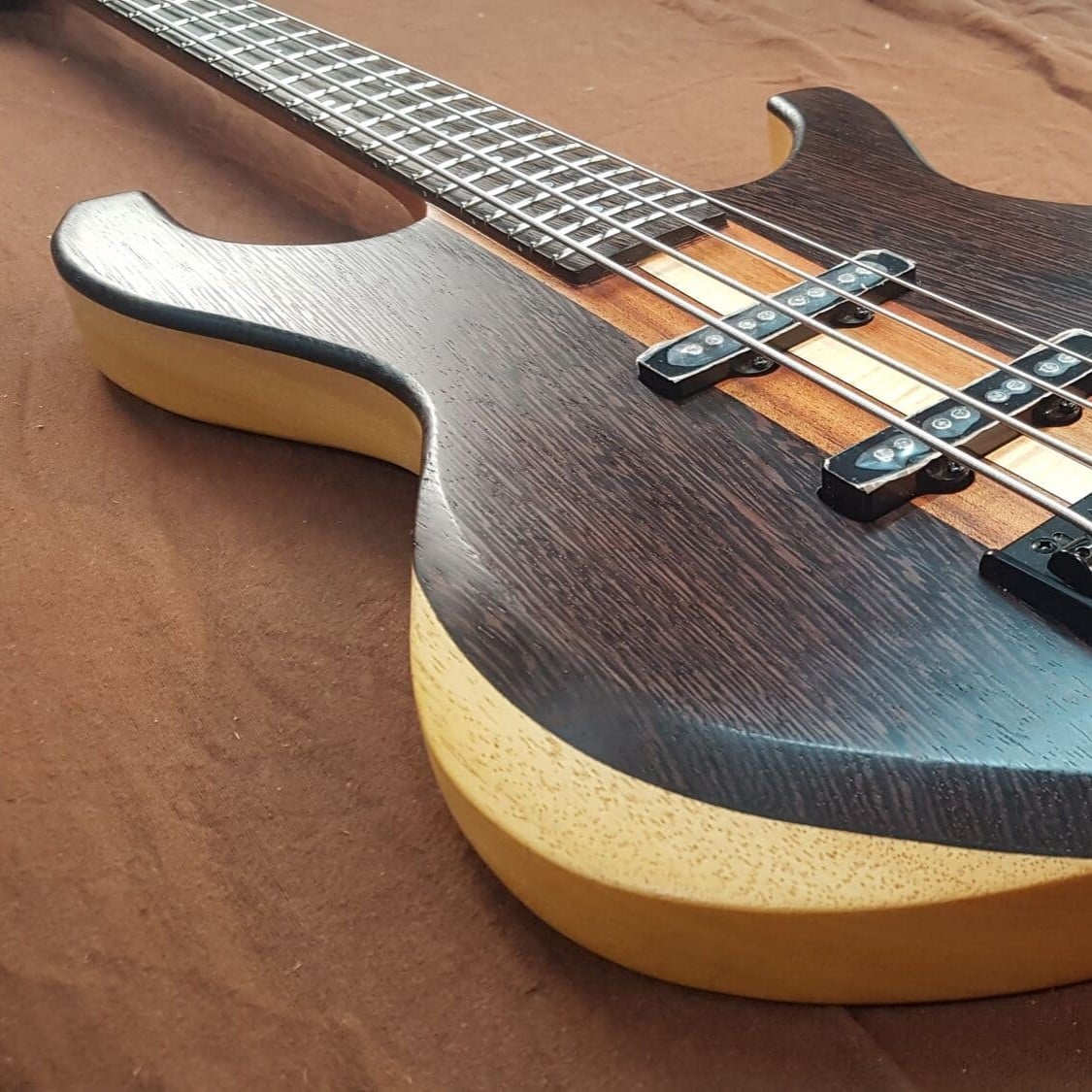
Body: Meranti Body with flamed maple cap
Neck: Quarter-sawn Mahogany with ebony fretboard
Inlays: No inlays on front MOP 2mm side dots only
Mother of Pearl ‘Rho’ symbol on truss rod cover
Bridge: Hardtail string thru body
Hardware colour: Black
Pickups: Two Wilkinson humbuckers
Electrics: Master Volume, Master Tone with push pull to activate coils cut, and three way switch.
Finish: Natural Satin
Custom: Headstock and body shape, chambered body.
The SpaceShip – First Docking Procedure
Mar 5th
Fitting the neck to the body with a dovetail joint
- Archtop guitar dovetail jig
- The dovetail slot in the body
- Archtop guitar dovetail front view
- Neck dovetail ‘test piece’
- The neck dovetail jig
- The ‘neck test piece’ is dovetailed
- The actual neck is machined
- A perfect fit
- Gluing the neck extension
- Close up of neck extension
- Ready to fit the truss rod
- Installing the truss rod
- Aligning the fretboard
- Rear view
- Ready to glue the fretboard
- Clamping the archtop guitar fretboard
- Gluing the ‘wings’ on the side of the headstock
- Custom headstock designed by Steve
- Rough carving the neck
- The neck is now roughly carved
Captains Log
Stardate : 05312.5
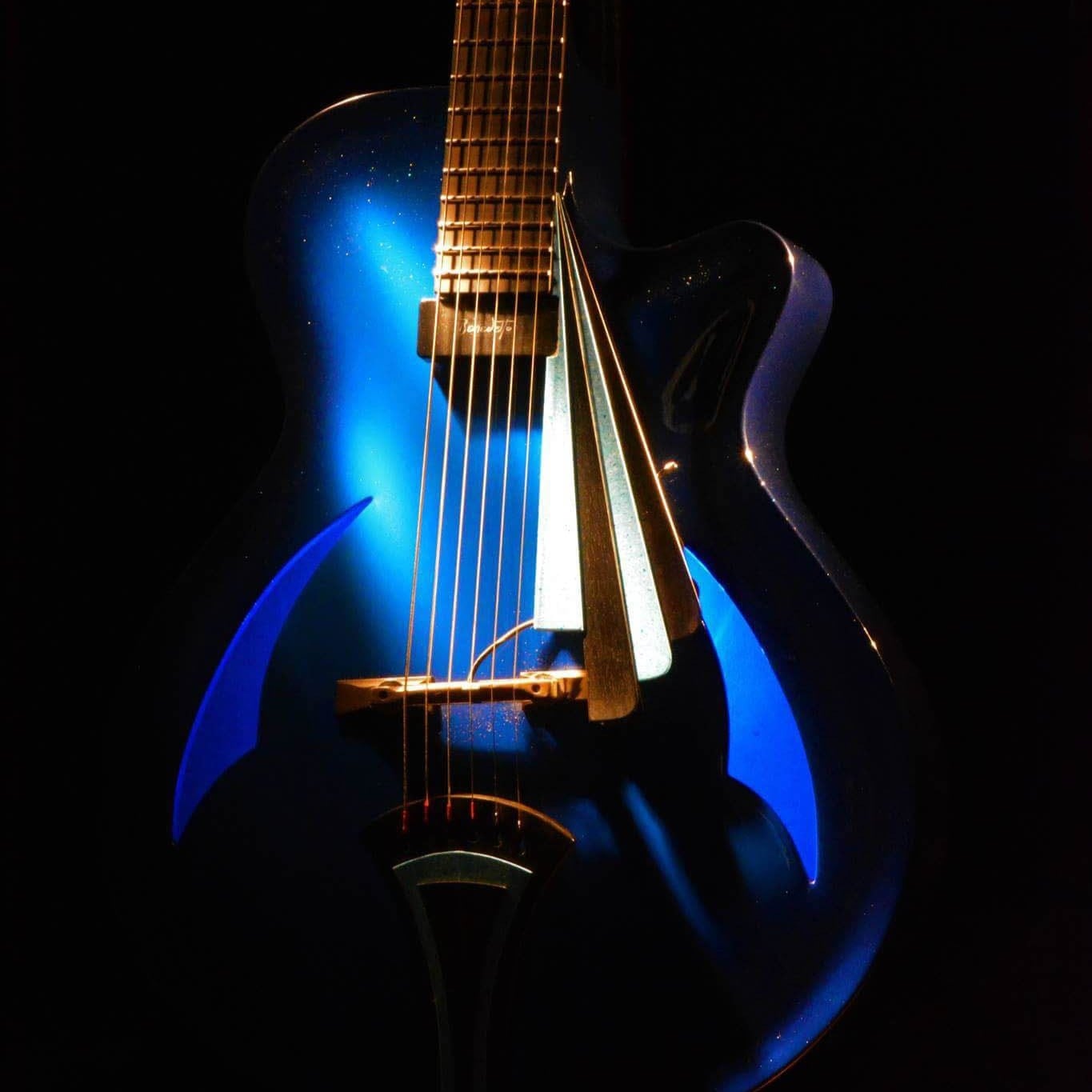
Today we passed a milestone in our continuing journey to go where no Jazz Archtop has gone before. It was my duty as captain to single handedly complete the first docking procedure with the new jazz class spaceship. It is necessary to ensure this runs smoothly as we do not want any issues to arise when the time comes to permanently attach the neck to the body.
The neck cannot be glued on until the guitar is just about finished during the final ‘docking procedure’, but the dovetail must be made before the fretboard is glued on or the neck would not fit into the jig.
Completing the neck joint is one of the major jobs when making an Archtop style guitar. It has to be a dovetail as there is no way to get hands inside the body to tighten any bolts.
This is also how the neck angle is set so that the strings will arrive at the right height for the bridge, and also the alignment- the centre of the neck must align with the centreline on the body.
The body mortice is cut first then the fitted neck to it, using a piece of ‘scrap’ to practice on until the angle and alignment is correct, then swapping it for the real neck to complete the dovetail joint.
After this I can glue the neck extension, install the truss rod and glue on the fretboard.
This headstock is going to be quite large so I added some ‘wings’ to each side to increase the width so the shape will fit on.
Steve designed his own headstock which I traced and marked out onto the wood before drilling the tuner holes and cutting out the shape.
Finally I rough carved the neck. I left it slightly oversized for now and will refine it after the frets are fitted. I may have to work on the fretboard first so it is good to leave a little leeway for this. Now I will let it settle for a while…
Contact us if you would like to commission your own epic custom build, or visit our online shop to see some ready made examples.